
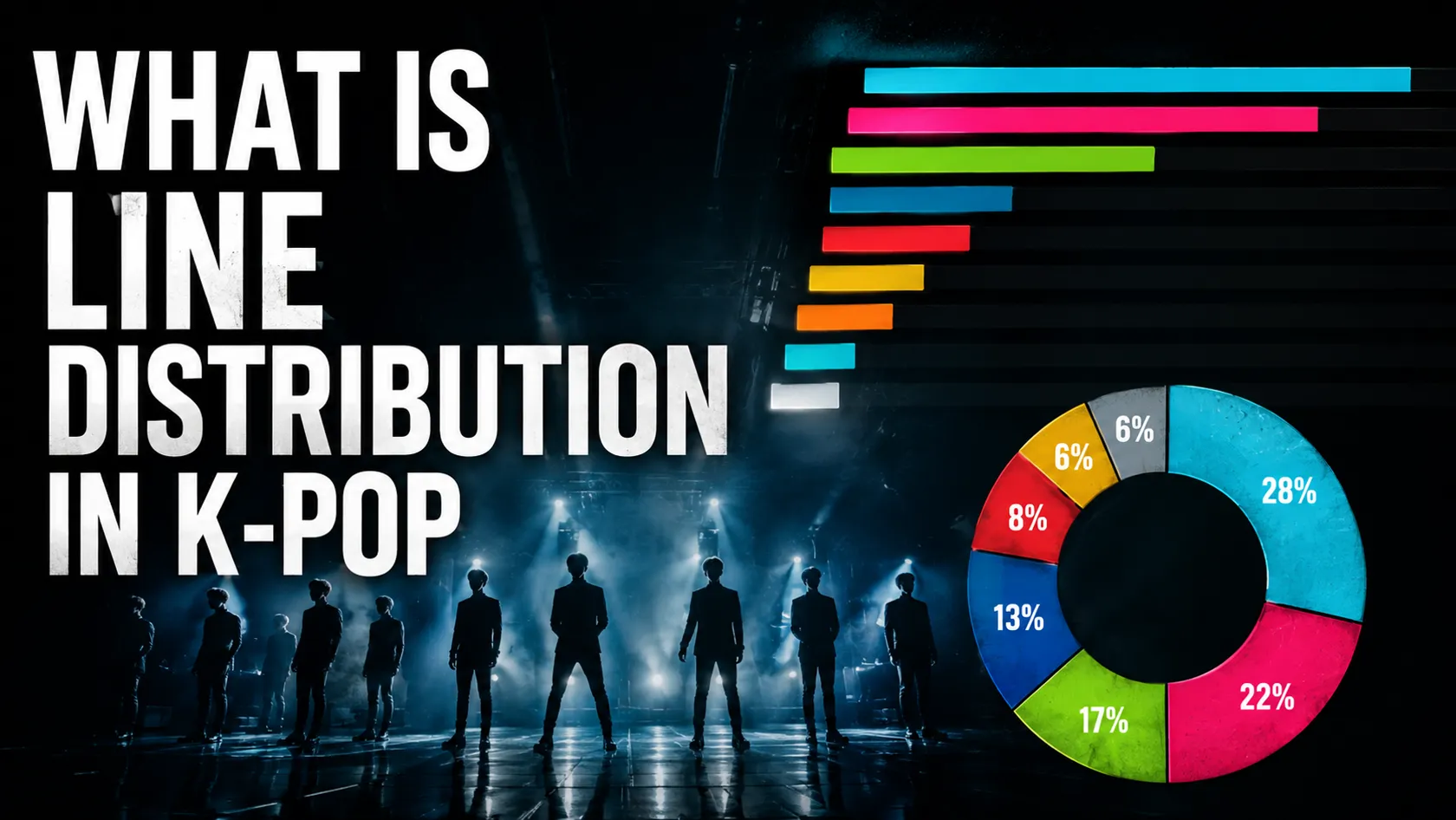
Line distribution in K-pop is the way a song's vocal and rap parts are divided among the members of a group. A line distribution chart or video usually shows how much each member sings, often as a duration, percentage, and ranking.
Despite the name, a “line” does not always mean one printed line of lyrics. It may mean a phrase, a rap section, an ad-lib, or any other part assigned to a particular voice. That is why many fan-made distributions measure time in seconds instead of simply counting lyric lines.
Line distribution is useful for understanding participation in one song, but it is not a complete measure of a member's importance or treatment. It does not automatically show vocal difficulty, screen time, center time, performance impact, or the creative reasons behind the arrangement.
Line distribution meaning, in simple terms
Imagine a four-member group releases a three-minute song. One member performs most of the chorus, another leads the verses, a third has a rap section, and the fourth sings a bridge and several harmonies. A line distribution records those parts and compares the members' contributions.
A typical result might answer questions such as:
- Who has the most counted singing or rap time?
- What share of the measured parts belongs to each member?
- Where does each member appear in the song?
- Are the measured times relatively even or concentrated among a few members?
Most K-pop line distribution videos are fan-made analyses rather than official documents from an artist or entertainment company. Their results depend on what the creator counts and how accurately they identify each voice.
What does a line distribution chart show?
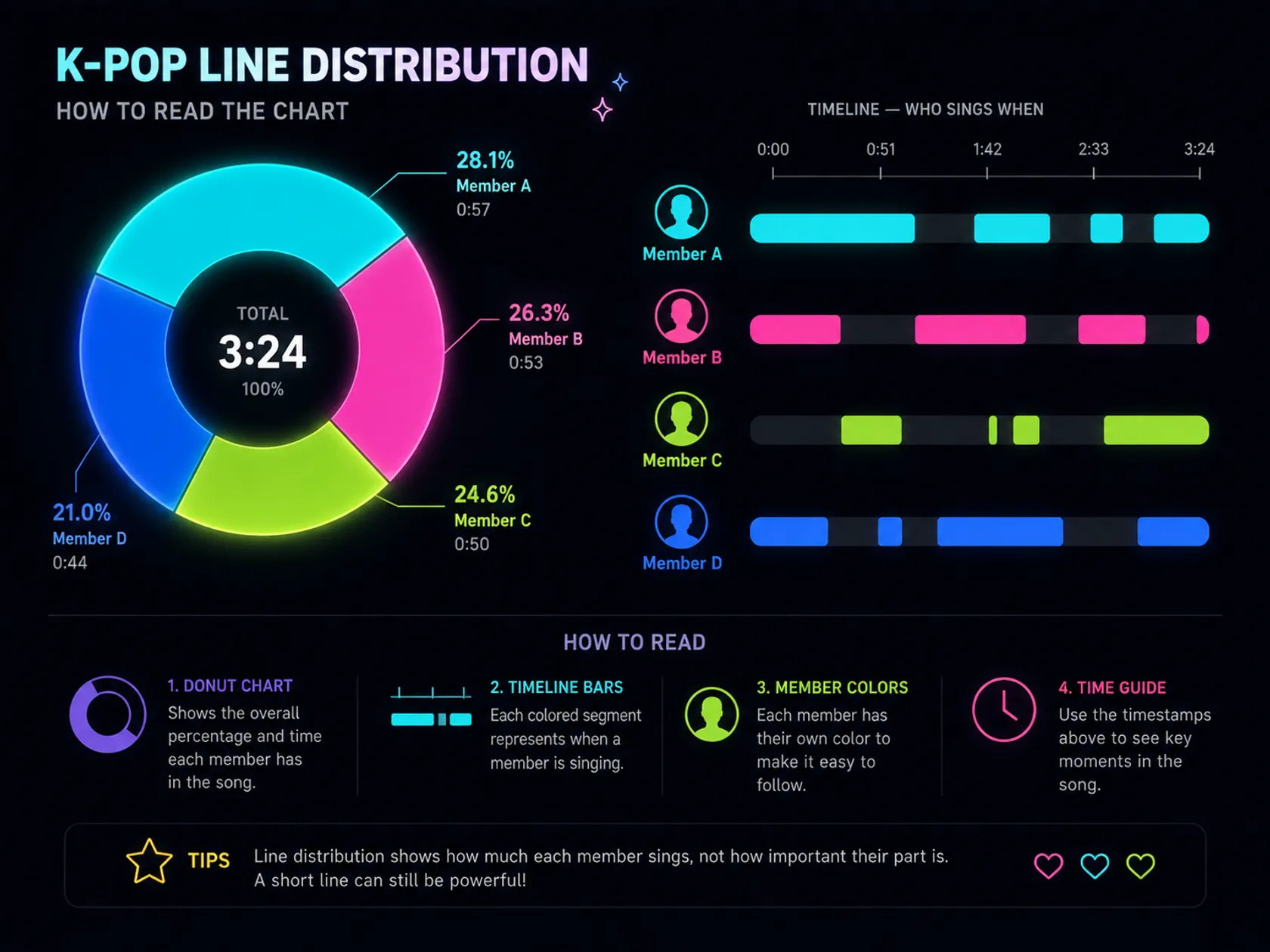
Different creators use different layouts, but these are the most common elements:
| Metric | What it means | What it does not prove |
|---|---|---|
| Member time | The total duration assigned to one member | How difficult or memorable those parts are |
| Percentage | That member's share of the counted vocals under the chart's method | Their share of the entire song, career, or performance |
| Ranking | Members ordered by their measured total | An official ranking of talent or importance |
| Vocal segments | The places where a member is counted as singing or rapping | That every backing layer or group vocal was identified |
| Coverage | How much of the audio timeline was tagged | That higher coverage is always more accurate |
| Fairness score | How evenly the recorded time is spread across members | Whether the arrangement is artistically or morally fair |
The label matters as much as the number. A chart titled “main vocals only” can reasonably produce different totals from one that includes ad-libs, harmonies, spoken parts, and group chants.
How is K-pop line distribution measured?
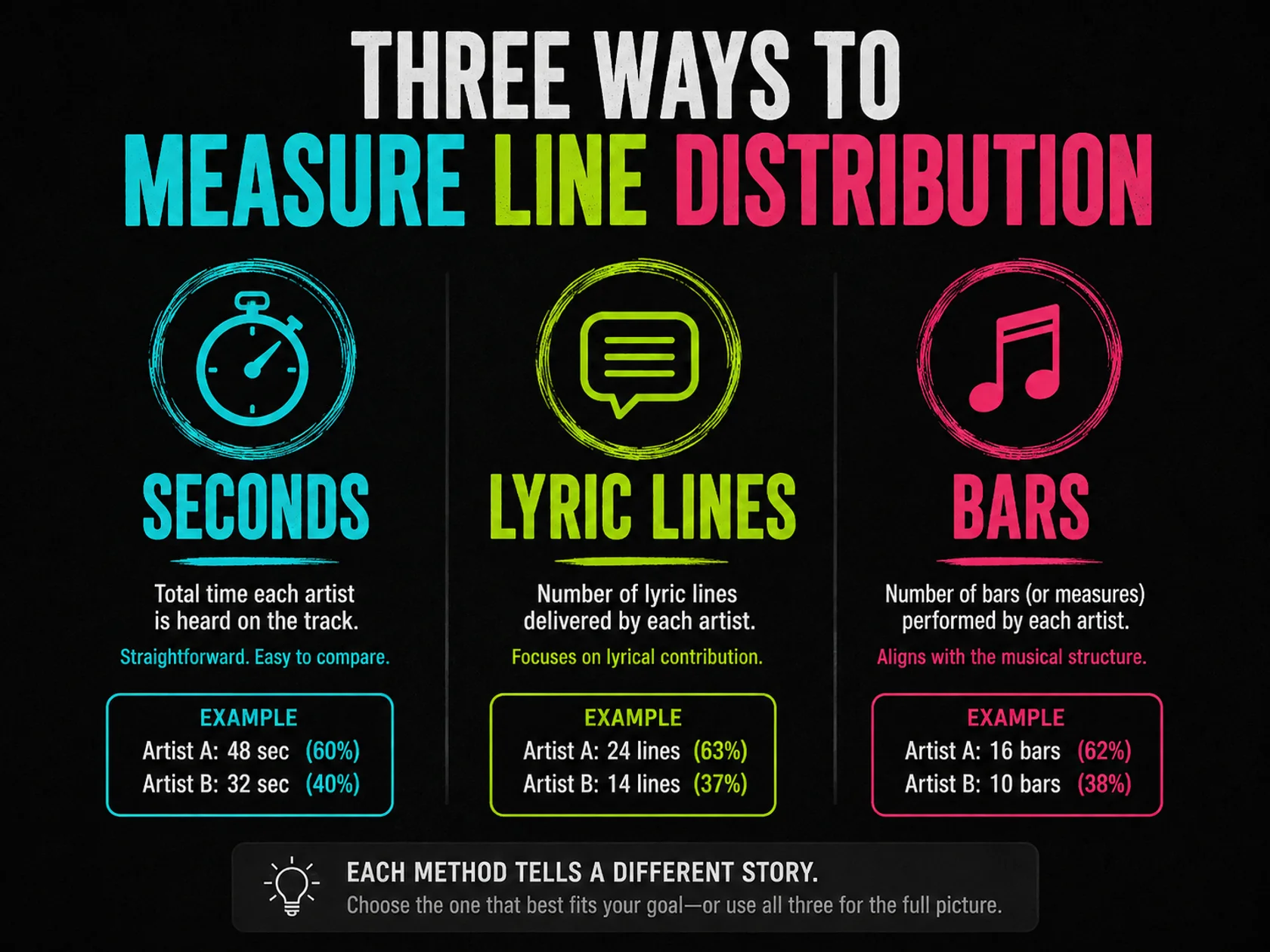
There is no single official measurement standard used by every fan, channel, or tool. Three methods are common.
1. Time in seconds
The creator starts a timer when a member's part begins and stops it when the part ends. All recorded segments are added to produce that member's singing time.
Time-based measurement works well for sustained notes, rap sections, and parts with different phrase lengths. It also makes an animated line distribution video easy to follow. However, the result still depends on decisions about pauses, breaths, overlaps, and background vocals.
2. Lyric lines or phrases
The creator counts how many written lines or vocal phrases each member receives. This method is easy to understand, but one short phrase and one long chorus line may each count as a single line. Formatting can also change the result: the same lyric can be written as one long line or split into several shorter ones.
3. Musical bars or sections
Some analyses compare bars, beats, or song sections. This can reflect musical structure better than printed lyric lines, but it requires more interpretation and can be awkward when parts begin between bars or several members overlap.
| Method | Best for | Main limitation |
|---|---|---|
| Seconds | Comparing audible duration | Timing rules affect the totals |
| Lyric lines | A quick text-based count | Lines can have very different lengths |
| Bars or sections | Comparing musical structure | More complex and less intuitive for casual viewers |
No method is automatically correct for every song. A useful distribution states its rules and applies the same rules to every member.
Why can two line distribution videos show different results?
Two careful creators can analyze the same recording and still produce different numbers. Common reasons include:
- Ad-libs: One creator may count every audible ad-lib, while another counts only lead parts.
- Backing vocals: Background layers may be included, excluded, or difficult to identify.
- Harmonies and duets: Multiple members can sing during the same second. Some charts count everyone involved; others credit only the most prominent voice.
- Group chants: The section may be assigned to all identifiable members, placed in a separate “all” category, or left uncounted.
- Shared words: A handoff within a syllable or phrase does not always have an obvious boundary.
- Voice identification: Processed vocals, layered production, and similar vocal tones can make a singer uncertain.
- Timing precision: Creators may choose slightly different start and end points for the same phrase.
For that reason, a difference of a few tenths of a second is rarely the most important issue. Clear counting rules and consistent treatment of every member make a chart more useful than false precision.
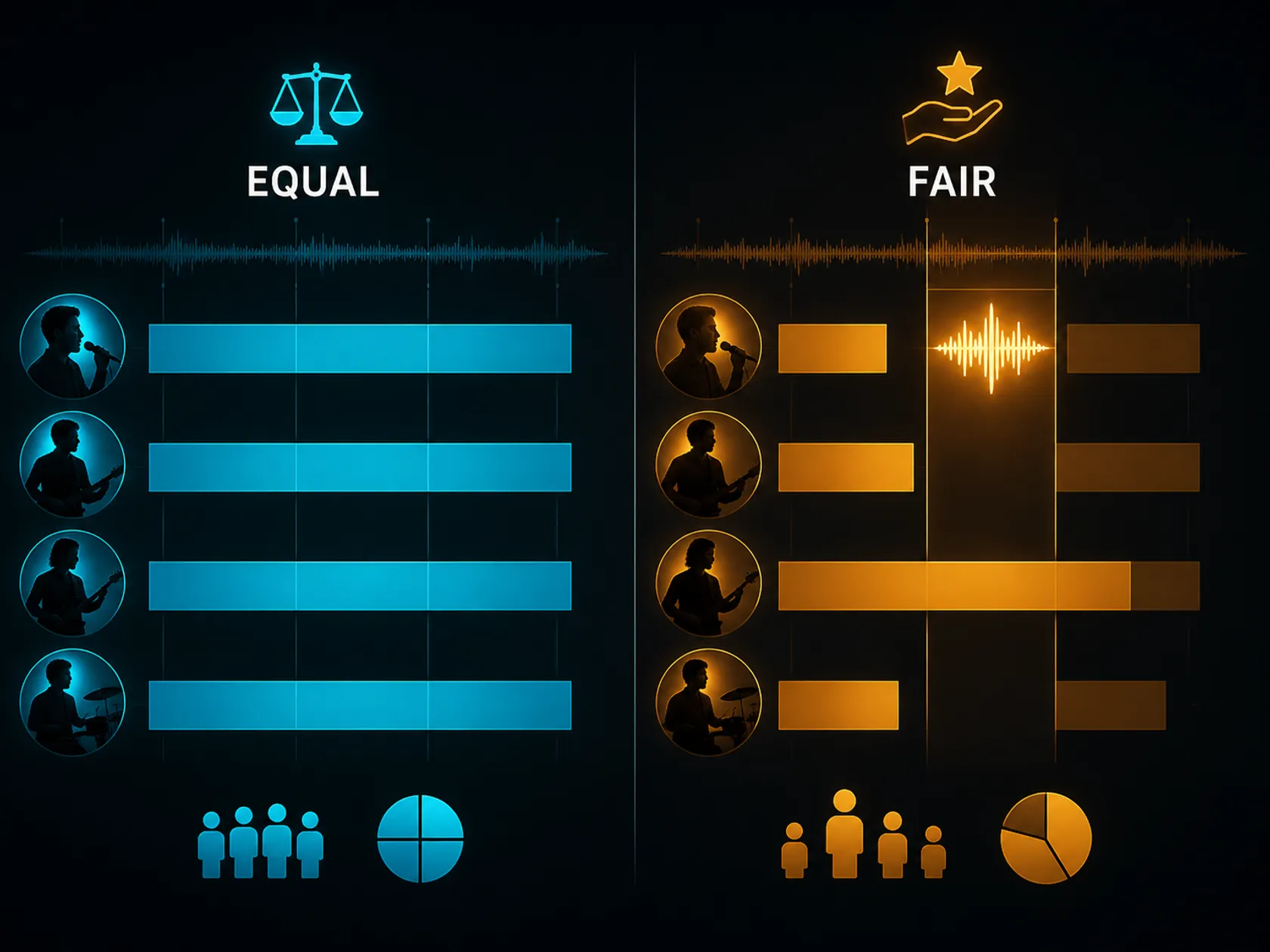
Is equal line distribution the same as fair line distribution?
No. Equal is a mathematical description: every member receives the same measured time. Fair is a judgment that depends on what listeners believe the song and group should prioritize.
An equal split may make sense for one song, but K-pop arrangements can also reflect vocal range, tone, rap roles, concept, language, song structure, and the sound the producers want for a particular section. These factors may influence an arrangement without making any single distribution rule universal.
Likewise, fewer seconds do not by themselves prove that a member was treated unfairly. A short high-impact bridge, opening line, killing part, or difficult harmony may matter more to listeners than a longer repeated phrase. To discuss fairness responsibly, look at several songs and several kinds of contribution instead of treating one timing chart as a final verdict.
A numerical fairness score should therefore be read narrowly. It can describe how even the recorded durations are; it cannot judge vocal difficulty, artistic intent, or whether each member received the right part.
Line distribution vs. center distribution vs. screen time
These terms describe different parts of a K-pop performance:
| Type of distribution | What it measures | Example question |
|---|---|---|
| Line distribution | Assigned vocal and rap parts | Who sings this chorus? |
| Center distribution | Time or frequency in the central choreography position | Who leads the dance formation? |
| Screen-time distribution | Time visibly shown in a music video or performance edit | Who appears on camera most? |
A member can sing while another member is centered or shown in a close-up. Someone can also have few solo lines but appear prominently in the choreography. Combining these three measurements can give a broader view, but even then they do not capture every contribution, such as dance difficulty, harmonies, songwriting, stage presence, or leadership.
Why do K-pop fans track line distribution?
Fans use line distributions for several reasons:
- to learn which member sings each part;
- to compare participation within a song or across a release;
- to visualize fast vocal handoffs and overlapping parts;
- to discuss changes in a group's sound or member roles;
- to create data-based fan videos, charts, and song guides.
The format turns something listeners hear into a visual timeline. That makes it helpful both for new fans learning voices and for longtime listeners analyzing an arrangement. The healthiest interpretation is descriptive: the chart shows what was counted under a stated method, not everything a member contributed.
What line distribution cannot tell you
A timing chart alone cannot reliably measure:
- how high, low, or technically difficult a part is;
- whether a vocal is live, doubled, processed, or supported by another member;
- how memorable a killing part is;
- center time, screen time, or dance focus;
- emotional delivery or audience response;
- songwriting, production, leadership, or behind-the-scenes work;
- why the final arrangement was chosen;
- a member's value to the group.
It is also not the same as an official vocal credit sheet. Unless an official source identifies every layer, fan-made distributions necessarily include some listening-based judgment.
How to make your own line distribution
You can measure a song without building timers and animated bars in traditional editing software. In Line Distribution, add the members, load the audio or MV, and toggle each member while listening. Multiple timers can run at the same time for clear harmonies or overlapping vocals, and the tool calculates the durations, percentages, ranking, coverage, and timing-based fairness score.
Decide how you will treat ad-libs, background vocals, and group parts before you begin. Then replay uncertain transitions and review the results before sharing them.
For a full walkthrough with product screenshots, read How to Make K-pop Line Distribution Videos Online.
Measure a K-pop line distribution →
Frequently asked questions
What does “line” mean in K-pop?
A line is a vocal or rap part assigned to a performer. It may be a lyric phrase, several words, a full verse, an ad-lib, or a shared section. It does not have to match one visually printed line of lyrics.
Are K-pop line distributions official?
Usually not. Most charts and videos are created by fans who identify the voices and apply their own counting rules. Official stems, session information, or detailed vocal credits may not be publicly available.
Does a member with the most lines always sing the most seconds?
Not necessarily. A member can have many short phrases while another has fewer but longer notes or sections. A lyric-line count and a time-based distribution can therefore produce different rankings.
Do ad-libs and backing vocals count?
They can, but the creator should state the rule. Including clearly identifiable ad-libs and backing vocals gives a broader picture of vocal participation; excluding them can make the lead-line analysis easier to compare. Consistency is more important than choosing one universal rule.
Can two members receive time at once?
Yes. When two or more identifiable members sing simultaneously, a time-based method can count the same moment for each active singer. This means the combined member time may exceed the song's duration.
Why is coverage lower than 100%?
Coverage can be below 100% because intros, instrumentals, dance breaks, silence, or uncertain sections are left untagged. It is a review signal, not a requirement that every second of the song must belong to a member.
Does an even distribution mean the song is fair?
It only means the measured time is relatively even. Whether the arrangement feels fair also depends on the parts' difficulty and impact, the group's roles, the song, and the listener's criteria.
The key takeaway
Line distribution is a way to describe how a K-pop song's singing and rap parts are shared. The most useful charts explain what they count, apply that method consistently, and treat the results as one view of the arrangement—not as a complete ranking of the members.
If you want to analyze a song yourself, open Line Distribution, add the members, and record each vocal change directly in your browser.